John Nephew


Maplewood City Council Policy & Politics


Monday, March 28, 2011

Today's Open Market Special: Red Herring

Before tonight's public hearing, I wanted to finish responding to the last of the talking points that NSWMA gave to us to support their position opposing any further discussion of organized collection. (Here's a link to all of the entries on this topic.)

The fourth and final set of NSWMA arguments display some pride in various accomplishments of waste haulers. Perhaps it is justified. However, in terms of actually illustrating distinctions between open hauling and organized collection, they're all red herrings -- rhetorical distractions designed to make us think positive things about waste haulers, and thus incline us to agree with their trade association, though the points are logically irrelevant to the issue at hand.

4. THE OPEN MARKET IS CONSTANTLY INNOVATING FOR THE BENEFIT OF CUSTOMERS IN LIGHT OF PRESSURE OF IMMEDIATE AND CONSTANT COMPETITION.
• An open market with competition is the best way to drive innovation, efficiency, and value. Value is not just price, but the combination of price, service, and environmental protection.

I have a few thoughts in response to this.

First of all, it seems to me that a basic element of an open market is that either party to a transaction can choose to walk away. In the case of trash hauling, residents are required to buy a service from a limited list of sellers. And that's only the tip of the iceberg of mandates, regulation, and barriers to entry that looms over the entire solid waste management sector. So whether or not this statement about "open markets" is true, it is irrelevant to Maplewood's situation where there is not a true open market.

Second, I would suggest that competitive bidding for neighborhoods is certainly competition, just like doing it house by house. Indeed, I would argue that it enhances the pressure toward value and innovation. Changes that would never be made at the request of just one household may be accommodated in order to win a contract for thousands. Cities with organized collection have the leverage to be on the leading edge of service options and improvements. Since most American cities have organized collection, it seems quite plausible that many innovations would be introduced first in response to the requests and requirements of large blocks of customers that those cities represent, then offered to the open hauling cities. If there is some evidence that only the household-by-household competition of open hauling cities drives innovation, NSWMA hasn't provided it. Lacking such evidence, this point is also irrelevant as an argument in favor open hauling.

Third, when it comes to efficiency, open hauling by definition means running multiple trucks and crews down the same routes. If a hauler establishes a commanding market share, and thereby increases efficiency, then it also loses the competitive pressure assumed to keep down prices. So it seems there's a little tension between the "efficiency" and "value" propositions -- or at least there's a point where increasing one is at the expense of the other. Organized collection, with its neighborhood-wide approach, can achieve both efficiency and value.

Finally, while I certainly appreciate the strides made by the waste industry toward environmental responsibility, I'm just not ready to accept the NSWMA's implication that it was all driven by the free market and corporate altruism, or that none of it came from pressures in the organized collection markets in which many of the same haulers work. Based on the track record of skewed and misleading information in NSWMA's communications to date, I'm going to assume the story is not exactly how they tell it. How many of those innovations in environmental protection came because of outside pressure -- such as government mandates, or actual or threatened lawsuits?

As I look at the NSWMA's lobbying priorities on their website, they suggest ongoing efforts to thwart the public interest in favor of their own short-term profits, flying in the face of their high-minded claims. A good example is their opposition to flow control (government requirements about where trash can go based on environmental priorities and the long-term public costs, as opposed to allowing haulers to take it wherever they can dump it most cheaply).

Continuing with their talking points...

• Private sector waste companies are innovators in reducing truck emissions.

Again, how much of those reductions are voluntary or driven by competition for individual customers? How many are in response to federal and state air quality regulations? And perhaps more importantly, how or why would it be any different under organized versus open hauling? As it stands, this point is irrelevant to our discussion, since it doesn't change no matter which system we use.

• Today's private sector hauling fleet puts "more rubber on the ground" effectively spreading the total load across the road. With open hauling this advantage is increased.

This statement reminds me of those ads for a 50% off sale that gush "the more you buy, the more you save!"

It's great that truck designs are improving to reduce wear on streets, and I appreciate the implicit acknowledgment that trash trucks' wear on streets is a problem worth addressing. I can't imagine they'd spend money on fleet upgrades if they had proof that it didn't matter. But imagine if we had just one truck spreading its load more effectively on one of our residential side streets, instead of three, four or eight...?

In other words, as an argument for open hauling, this is irrelevant. It works just as well as an argument for organized collection.

• Private haulers have supported the separate collection of yard waste for many years and designed collection systems that are efficient and customer friendly.
• Private haulers have been innovators in recycling programs and dramatically increased citizen participation in the amount of material recycled.

These statements may be true, but still don't demonstrate any benefit of open hauling over organized systems, given that private haulers are typically doing the work in both cases.  Again, we would need some reason to believe that these innovations come exclusively from open collection systems (whether trash or recycling), and then spread to organized cities.  It seems more likely that the reverse is the case.  We do know that studies have found that organized collection increases recycling. One referenced in the 2009 MPCA study found 13.5% more recycling pounds per households in cities with organized recycling collection, for example.

Lacking any explanation of why these final points, praiseworthy though they may be, distinguish open hauling from organized collection, we'll just have to identify them as red herrings written to evoke sympathy as well. Throw 'em in the trash bin along with all the other factual errors and logical fallacies that make up the bulk of NSWMA's arguments.

Perhaps we should say recycling bin, since I have no doubt that the same red herrings will be pulled out, dusted off, and offered to the next Minnesota community that tries to start a conversation on this topic.

Labels: ,

Sunday, March 27, 2011

Administrative Expenses and NSWMA's Double-Billing

The next group of NSWMA talking points have to do with the fact that it takes some effort for Maplewood to switch to an organized collection system, and there would be some administrative costs after switching. While this basic point is true, they still manage to get the details wrong.

3. CURRENT SYSTEM INVOLVES NO ADDITIONAL COST TO CITY

This statement might mislead some readers into thinking there are no costs to the city under the current system. We currently must allocate staff resources to licensing haulers, and state law (Minnesota Statutes 115A.941(a)) requires us to enforce our mandatory collection ordinance, for example. The NSWMA doesn't mention that a reduction in the cost of administering the current system would offset some expenses of an organized system.

• No City consultant needed at a price of $60,000.

City staff gave us three scenarios for the planning phase at our February 7th workshop. (You can read the meeting packet online with the details.) They gave us options of (a) all the work being done by city staff (which would take longest, as it gets stacked on top of their other day-to-day duties and requires them to learn about a lot of technical issues in order to do it), (b) some being done by staff and some by consultants, and finally (c) just putting it all in the hands of an outside consulting firm with expertise in this area.

The last option was estimated to cost a maximum of $60,000, but we didn't have any actual bid or quote.  Its scope would include "initial kick off meetings, resolution of intent to organize, draft organized system plan, discussions and negotiations with haulers, findings and final organized system plan, public relations and advertising, and project management."

The proposed funding source was the city's SCORE grant ("Select Committee on Recycling and the Environment"), funds that can only be spent on waste reduction and related activities, not property taxes.

We haven't yet selected one approach or another, since of course it depends on first deciding to move into a planning phase.  We may also change the scope (for example, in choosing whether or how much to spend on public relations and advertising related to the process) and reduce its potential cost.

It's unfortunate that specialized expertise is needed to make sure we follow all the rules and avoid the pitfalls in the statutory organized collection process. I believe you can thank the waste hauler interest groups that lobbied to make the rules as complex as they are.  They probably figured, rightly, that the more complex and cumbersome the process was made to be, the less likely any cities would actually follow it through and the more opportunities they would have to sabotage it along the way.

• No additional City staff needed for drafting, negotiating, monitoring, and enforcing contracts.

The assumed expenditure in the previous point already included the drafting and negotiating of hauling agreements, so it appears that NSWMA is double-billing us by listing it as a staff expense as well.

Come to think of it, that recent mailing which lists both the up-to-$5000 for public hearing preparation (including, for example, the postcard that the city mailed to notify residents of the hearing) and up-to-$60,000 for the whole potential scope of work (including all of the public hearing and resolution expenses), is charging us twice for the same thing as well.  This is starting to look like a habit.

In any case, as with their shameless distortions of public opinion data, this another example warning us that we simply can't trust NSWMA to give us accurate information.

• No additional City staff needed to field complaints from citizens about contract hauler.

This is a repetition of the "monitoring, and enforcing contracts" part of the previous point. Staff addressed it in the report for our February 7th workshop:

Administration of Collection System Contracts

During the November 2010 workshop, the city council inquired about the cost of administering a collection system contract. Administrative costs vary depending on how a contract is structured, i.e., whether the contractor or the city does the billing, customer complaints, education, etc. Using the administration of the city’s recycling contract as an example, the city budgets 20 percent of one employee’s time to this administration. This is equivalent to approximately $18,000 yearly.

As I've said many times before, I want to keep the city's role minimal -- the haulers should handle billing, customer service, etc., with the city only stepping in if a problem can't otherwise be resolved or it's otherwise necessary to enforce some part of the contract.  (Our recycling contract enumerates liquidated damages for various service failures, for example.)  So I would expect the administrative load to be comparable if not less than what is involved in the recycling contract.  And as I mentioned before, organized collection would likely mean a reduction in other current city administrative expenses.

To put that up-to-$18,000-per-year in perspective, I've run various estimates on what organized collection would be likely to save for Maplewood households compared to their current bills.  I come up with numbers in the hundreds of thousands of dollars per year.  Seems to me like a pretty good return on investment, without even adding in the other benefits to the environment and our residents' health.

Labels: ,

Saturday, March 26, 2011

Informal Survey Finds Majority of Bogus Polls Support NSWMA

Continuing with those NSWMA talking points:

70% of Maplewood citizens in City conducted poll opposed government managed organized collection.

Sounds impressive, doesn't it?  Though you might be wondering, "What city-conducted poll?  Why did I hear nothing about this?"

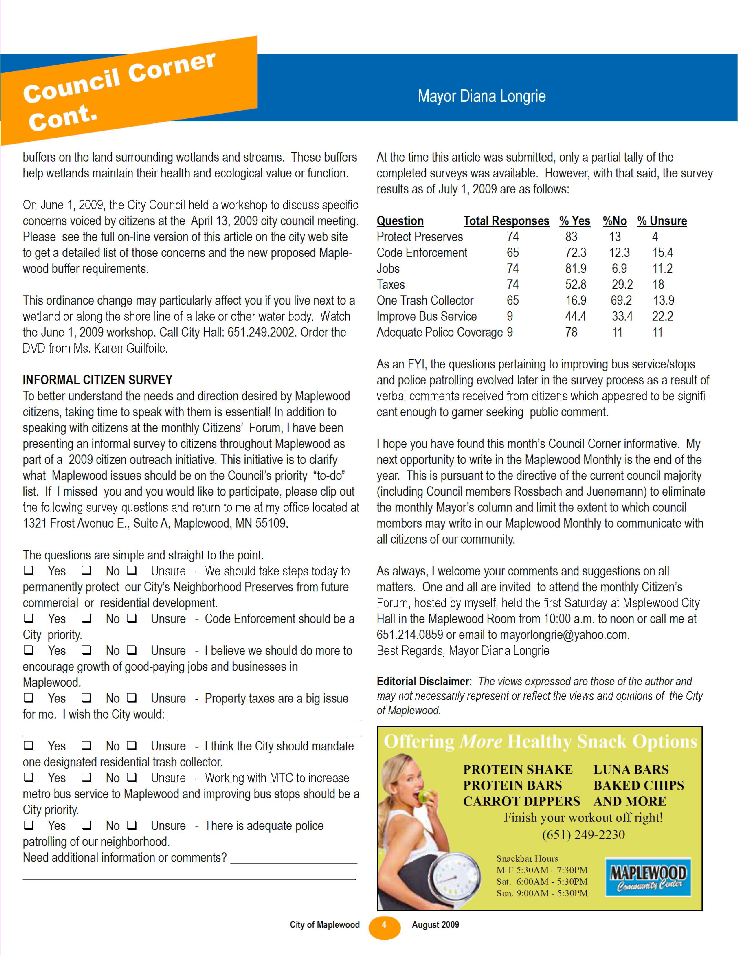
In the August 2009 city newsletter (here's the page), then-mayor Longrie described her "informal survey to citizens throughout Maplewood as part of a 2009 citizen outreach initiative."  That sure sounds like a euphemism for "reelection campaign," especially when paired with a list of potential campaign issues for testing.  And she asks you to send opinions to her "office" -- not city hall, but her law office/campaign headquarters.

Her opinion article tells us that, of the first 65 people Diana Longrie thought to ask if "the City should mandate one designated residential trash collector," 45 of them said no.  I would not surprise me if a large majority of them also predicted her landslide re-election.

Needless to say, like the so-called polls of NSWMA, this is useless in terms accurately measuring resident opinion.  It certainly raises questions about the reliability of any information that NSWMA gives us, if they're willing to offer this as a data point.

I should add: Apparently the City of Maplewood once hired an outside firm to do a real survey of residents on a variety of city topics, back in 1996, including organized collection.  That survey found that 57% of residents supported some form of organized collection.

While mysteriously failing to mention that survey, the NSWMA goes on to talk about their own postcard "poll":

Over 1,000 households in Maplewood expressed their opposition to proceeding forward by sending postcards to the City Council before the special council meeting on October 4, 2010.

Of course, this means that up to 13,882 households didn't send in those postcards.

Let's put this in perspective. The NSWMA sent its mailer to many thousands of households, with pre-stamped postcards inside and a slanted letter designed to provoke a knee-jerk reaction. (They do this every time a community talks about organizing, and they have it down to an art.)  Easier to send in those postcards than to vote, wouldn't you say? I wouldn't say that Longrie successfully made organized hauling a campaign issue in 2009, but even she got more votes than NSWMA got postcards.

Labels: ,

Thursday, March 24, 2011

Belief Versus Fact

Returning to those NSWMA talking points...  We are told:

Many residents believe the competitive market will provide the best value (price and service) for any service they need.

Many residents have expressed their lack of confidence in government to provide long-term value (price and service).

Any number of people believing something does not make it true. I think public policy should be based on the most accurate available information, not mistaken beliefs, however many people might hold them.

No city has organized trash collection since the early 1990s. I think it's fair to say that every city in Minnesota that has organized collection is well into the “long-term” horizon. Yet rather than providing us with any evidence that would suggest service problems or high prices demonstrating a lack of long-term value in those many communities, the NSWMA is reduced to appealing to the unfounded beliefs of “many residents” as a reason to oppose organization.

In every study I've encountered so far, cities with organized collection have, over the long term, enjoyed comparable or superior service and lower prices compared to open hauling systems like Maplewood.

In a recent e-mail exchange with me, one resident cited a city where she believed the problems were an example of why not to have organized collection.  So I looked into it, and it's actually a city with open collection, just like Maplewood.  What has apparently happened is that the number of licensed haulers is down to only two or three.  Whether those haulers built their market share by competition, buying out rivals, or influencing the city's licensing process in some way to keep newcomers out, I can't tell you.  The result, from what this woman told me, is not to pass on any of the savings from efficiency with their customers, but to charge customers in this city even higher prices than the same haulers do in adjacent communities.  To me, this is a perfect illustration of the illusion of market freedom in the current system, and the motivation of some haulers in opposing change.  The history of trash hauler consolidation and vertical integration over the past two decades suggests we'll see more of this as time goes on.

Finally, as long as we're talking about what “many residents believe,” we might also acknowledge the many residents who have a lack of confidence in corporations to properly account for long-term costs as opposed to short-term profits, especially when they have a long history of successfully dumping those costs on taxpayers and the public at large long after the fact.  Unlike the beliefs cited by NSWMA, this one seems to have some awfully good trash-industry-specific data to support it (see, for example, closed landfill clean-up costs).

Labels: ,

Thursday, March 17, 2011

What Is Choice Worth?

Any plan for organized collection could expand certain choices for the consumer (for example, allowing more container size options or services that some haulers don't currently offer). But reducing the number of haulers means limiting some other choices. Several NSWMA talking points restate this observation in different ways.

2. ON BALANCE, RESIDENTS PREFER THE USE OF THEIR CHOSEN PRIVATE COMPANIES FOR HAULING SERVICES.
• Freedom of choice is very important to residents.
• Many residents prefer to make buying decisions without influence of government.
• The open market allows residents to easily switch haulers when they are not happy.

Unfortunately, Mr. Carnival gives us an unbalanced view, weighted entirely toward open hauling. All else being equal, people may prefer choice in almost anything – but it is rarely the case that all else is equal. Certainly it's not the case when it comes to trash disposal.

So the question is not whether people think choice is important (of course we do), but how important it is and which choices matter most. How much more money are residents willing to spend on hauling in order to maintain the feeling they have a "freedom of choice?" Would residents rather trade their choice of hauler for more choices among the services offered, or for control of other aspects of waste management (e.g., the choice not to bequeath overflowing landfills to our children)?

With respect to the "influence of government" on our choices, the fact is that government already has an enormous impact on our buying decisions about trash disposal. Not every Twin Cities hauler is licensed to do business in Maplewood, for example, and there are laws about what you can put in the trash.

I realize that some residents would prefer to have no government regulation of waste management at all, such as the resident who told me he's still angry that he can't use burn barrels to dispose of trash in his backyard. Our government's decision to disallow his open burning wasn't out of spite, mind you; it was because burning might have been cheap and convenient for him, but it shifted the ultimate but less-immediate costs of his trash onto his neighbors and the rest of the public, whose environment and health were harmed.  Regulations like this are part of what the Preamble of the U.S. Constitution explains as the purpose of American government, to “promote the general Welfare, and secure the Blessings of Liberty to ourselves and our Posterity...” Our Founding Fathers recognized that we need government to protect the interests of the people and the future generations who will inherit this great land.

As for the claim that the open market lets unhappy residents easily switch haulers, there's some argument to be made over how easy it actually is to switch haulers in practice. Haulers often entice us with introductory rates and long-term contracts, impose cancellation penalties, and make us jump through hoops to cancel service (such as having to call a different number and talk to someone whose job is to try and cajole you into staying with them).

More importantly, there's as question as to how much choice we really have as consumers, with only the leverage of one household each. Sure, we can choose based on price, but if that's all that really matters then the fact that prices are lower under organized collection should persuade us. Do we get to choose where our trash is hauled and how it's ultimately disposed of? Do we get to choose what kinds of trucks are used on our streets, or how many? Organized hauling can give us the ability to make these choices as a community, where open hauling does not.

Speaking for myself, the current consumer “choice” of trash hauler reminds me a lot of Henry Ford's famous line, that Model T buyers could choose “Any color, so long as it’s black.”

Labels: ,

Monday, March 14, 2011

A Remarkable Sense of Entitlement

Continuing my responses to the NSWMA's talking points provided by Douglas Carnival, I find that their next three points express a remarkable sense of entitlement, especially for an industry group that purports to advocate competition.

• A privately-held infrastructure has been built to serve this community need.

Many businesses have invested in privately-held infrastructure to serve public needs. Look at construction companies that do road and bridge projects, and how much they have to invest in heavy equipment. That doesn't entitle them to guaranteed returns on their capital; they still have to submit winning bids and actually do the work.

We live in a large and diverse metropolitan area, which predominantly has open hauling, as well as biddable contracts to serve organized communities. Anyone who fails to win a bid for part of Maplewood's business can continue to use the same infrastructure to serve other communities.

• Government intervention will result in loss of investments made by private companies without just compensation.

"Just compensation" is one of NSWMA's hobby horses. They believe that when communities decide to organize trash hauling with competitive bidding, as opposed to cartel-type arrangements that guarantee haulers their current market share and prop up their profit margins, that any companies who fail to compete successfully deserve a government handout to pay them for the work they're not doing.

Communities have been choosing various forms of organized collection in Minnesota for more than a hundred years. State law gives cities the cities and counties the explicit authority to do it, and lays out a specific process to follow. Waste in general is a highly regulated field on the state, federal, and local level, subject to constantly changing mandates and requirements. Courts have time and again found that organized collection does not constitute a regulatory taking for displaced businesses.

Given these facts, it's hard to imagine that any halfway competent business in the waste management field would fail to account for regulatory risk as part of their business plan and disclosures to investors. (Check out the Form 10-K SEC filings of the publicly traded haulers for examples.) Whether it's a public firm or private, that regulatory risk should be included in any valuation model used to calculate the company's worth.

Anyone who invests in or builds a company in this industry should know what they're getting into and take responsibility for their choices, not demand a government bailout disguised as "just compensation" if their investment turns sour.

• Small haulers may be forced out of the community and lose customers through no fault of their own.

I don't know if it's still the case, but last fall when I checked their membership list on the NSWMA website, none of Maplewood's small haulers were listed. Talking about "small haulers" is a rhetorical strategy, used to short circuit our logic and make us read the sentence in emotional terms and identify with the "little guy."

Another appeal to sympathy is embedded in the phrase "through no fault of their own." Look past the victim rhetoric at what it's saying: A company that fails to win a contract through a competitive bidding process is not responsible for that end result. Really? I have trouble believing that anyone who can offer this line with a straight face is really a believer in the market or competition.

So let's edit Mr. Carnival's phrase for accuracy:

"Large, multinational conglomerates headquartered in other states and foreign countries may lose customers through their unwillingness or inability to compete."

To which I would respond: So what?

Labels: ,

Friday, March 11, 2011

Does Your Hauler Love You?

Continuing their appeal to sentimentalism, NSWMA asserts:

• Customers have developed personal relationships with their haulers.

This seems like a broad generalization. Shouldn't they say some customers? If the claim is that all customers have developed personal relationships with their haulers, it sounds to me like they'll also have personal relationships with anyone who hauls their trash under an organized collection scheme.

What kind of relationship is it, anyway? Between the resident and the actual person picking up trash? Does it vanish then if the worker is fired or assigned a different route? Or with the owners/managers of the company? Does it vanish if there's a change of ownership? If it's a “personal relationship” with the corporation itself, what exactly does that mean? Do their Articles of Incorporation sometimes call you on weekends to ask for relationship advice?

I realize that some people may feel a sense of personal attachment to their trash hauler, whether it's from knowing the name of a guy they always see at the end of their driveway or a warm fondness for a particular color of truck. From a marketing standpoint, creating that sense of relationship is very valuable. A customer who who feels a personal connection to a brand is likely to stay a customer longer, even in the face of price increases and service problems.

But I don't see why the success of a corporation in implementing its marketing strategy should be what decides our city's public policy.

Labels: ,

Thursday, March 10, 2011

The "Tradition of Service"

The NSWMA talking points start with a rosy bit of nostalgia:

1. THE CURRENT FREE ENTERPRISE BASED CUSTOMER-CHOICE HAULING SYSTEM SUPPORTS A LONG-STANDING TRADITION OF SERVICE BY PRIVATE INDUSTRY.

Let me offer a counterpoint to their nostalgia with alternative view of the history of waste management.

The current system already includes a great deal of frankly intrusive government regulation, precisely because decades of unfettered "free enterprise" trash disposal led to environmental nightmares across the nation. American taxpayers have spent billions of dollars to clean up the messes left behind by private businesses who were focused primarily if not exclusively on serving their own bottom line. This "tradition of service" by private industry includes superfund sites, unlicensed dumps, toxic waste disposed right along with household waste, and perfluorochemicals contaminating groundwater right next door to Maplewood today.

Consider just one trash-related program just in Minnesota: the Closed Landfill Program set up in 1994. Through FY 2010, the program has spent a total of almost $341 million. So far, the former owners or operators of the landfills have contributed just $15.4 million toward that tab.

Trash management has become much better in recent decades, but let's be honest – many private haulers (and certainly their trade association) have been brought along kicking and screaming, invoking “free enterprise” as a bogus defense against efforts by government to protect the public good, the health of environment, and the quality of life on the planet we leave behind to our children.

Labels: ,

Wednesday, March 09, 2011

The Anti-Organization Perspective

After our February 28th meeting, when we voted on whether or not to call a public hearing on the trash topic, the City Council received a two-page list of talking points from Douglas Carnival, the attorney representing the National Solid Waste Management Association, arguing in favor of open hauling versus organization.

I am sure that the NSWMA will be spending some money to communicate their views directly to Maplewood residents in the near future, but if you don't want to wait for something to show up in your mailbox I scanned the document we received and put it online:


You probably won't be surprised to hear that I take issue with many of Mr. Carnival's points. At the risk of turning this into the "organized collection blog," I'll try to respond to as many as I can before our March 28th hearing.

Labels: ,

Older Posts

Posts by Date

Powered by Blogger & Blogger Templates. Customized by Michelle Nephew.
Contact me at
john@johnnephew.com